
Most dealers are familiar with the Simple Price Matrix, a basic markup table that applies a single markup percentage based on the item’s cost. The Progressive Price Matrix, however, applies markup tier by tier — allowing you to earn more profit by compounding margins across each cost level.
How each Matrix works
| Type | Calculation Method | Key Benefit |
| Simple Matrix | Uses one markup (factor) based on the total cost bracket the item falls into. | Easy to understand; consistent markup. |
| Progressive Matrix | Applies multiple markups progressively — each cost tier “max” is calculated by its own factor until reaching the total cost. | Increases total margin by compounding markups across tiers. |
The following examples use the same tire with a unit cost of $75.94 and the same factor table from the HITS Price Matrix.
Simple Matrix:
The Simple Matrix is a straightforward pricing method used in HITS to determine an item’s selling price based on a single markup factor. Each cost range (or Price Tier) is assigned a Factor, which represents the markup percentage that the system will use to calculate the selling price.
How It Works
1.) Each Price# in the matrix defines a cost breakpoint (for example, $10, $15, $25, $50, $75, etc.).
2.) Each Factor# defines the markup used to determine the selling price.
3.) The system identifies which tier your unit cost falls into and applies that one markup.
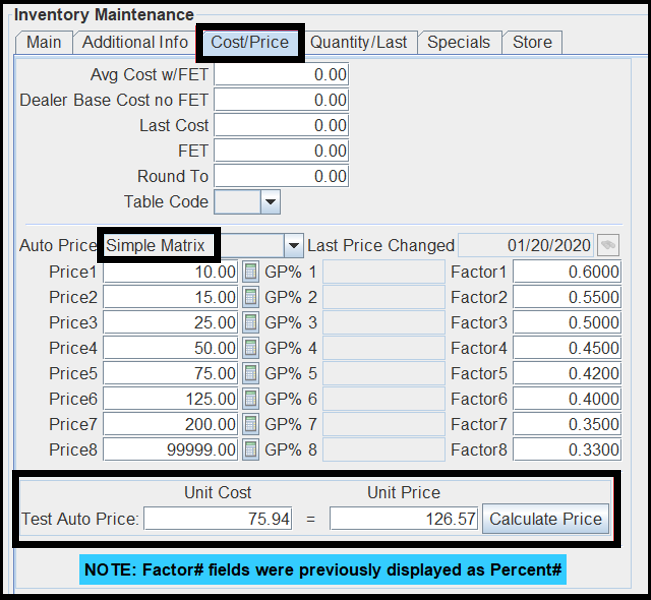
Using the following portion of the matrix:
| Tier | Cost Range ($) | Factor | GP% (Equivalent) |
|---|---|---|---|
| 4 | 25 – 50 | 0.4500 | 55% |
| 5 | 50 – 75 | 0.4200 | 58% |
| 6 | 75 – 125 | 0.4000 | 60% |
GP (Gross Profit) Calculation Simplified
Formula:
Selling Price = Cost ÷ (1 – GP%)
Example:
Cost = $75.94
GP% = 40% (or 0.40)
So,
= 75.94 ÷ (1 – 0.40)
= 75.94 ÷ 0.60
= $126.57
Note: For more information, review our HITS Markup Calculations document for the difference between Straight Markup vs. Gross Profit Markup
Progressive Matrix:
The Progressive Price Matrix is a more dynamic pricing method designed to maximize profits across a range of cost tiers. Instead of applying just one markup factor to the total cost, it applies multiple markup levels progressively, compounding margins across each costs’ max bracket up to the item’s total cost.
How It Works
1.) The system separates the total cost of an item into segments that fall within each Price Tier’s Max Cost.
2.) Each cost max is multiplied (or divided, depending on setup) by its corresponding Factor#, representing that tier’s markup level.
3.) The selling price from each tier is calculated individually.
4.) The system then adds all tier results together, from step #3, to determine the final selling price.
Note: See our HITS Markup Calculations document for more information on how to calculate prices based on type of markup.
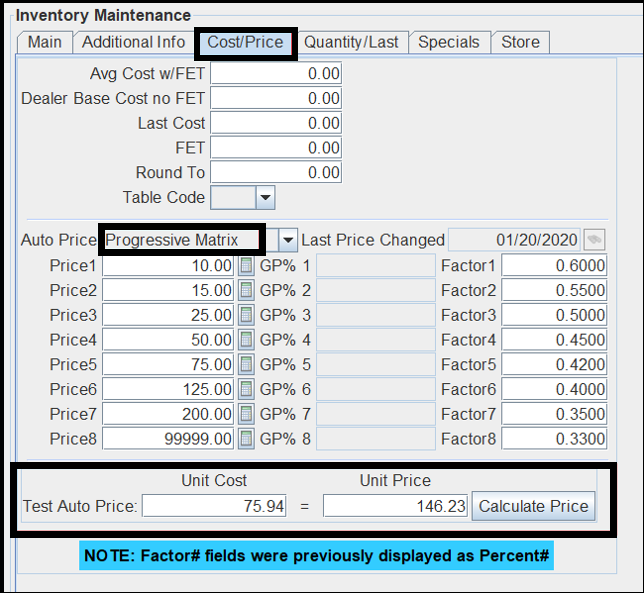
Progressive Matrix Example (Based on screenshot above)
In this example, the Progressive Matrix is used to calculate a selling price for an item with a unit cost of $75.94, resulting in a unit price of $146.23.
How the Price Was Calculated
1.) The system separates the total cost into portions that fit within each tier MAX up to $75.94.
Note: After you finish one tier, take that amount off the total cost before moving to the next one.
Example: If the total cost is $75.94 and the first tier covers $10, subtract $10 from $75.94. That leaves $65.94 for the next tier. Keep doing this until you reach the last tier.
2.) Each portion is then calculated by the corresponding Factor#, which represents that tier’s markup level.
3.) The results are then added together to produce the total selling price.
| Tier | Cost Range ($) | Factor | GP% (Equivalent) | Max Cost Allowed | Price per Applicable Tier |
|---|---|---|---|---|---|
| 1 | 0–10 | 0.6000 | 40% | $10.00 (75.94 – 10 = $65.94 left) | $10 ÷ 0.40 = $25 |
| 2 | 10–15 | 0.5500 | 45% | $5.00 (65.94 – 5 = $60.94 left) | $5 ÷ 0.45 = $11.11 |
| 3 | 15–25 | 0.5000 | 50% | $10.00 (60.94 – 10 = $50.94 left) | $10 ÷ 0.50 = $20.00 |
| 4 | 25–50 | 0.4500 | 55% | $25.00 (50.94 – 25 = $25.94 left) | $25 ÷ 0.55 = $45.45 |
| 5 | 50–75 | 0.4200 | 58% | $25.00 (25.94 – 25 = $0.94 left) | $25 ÷ 0.58 = $43.10 |
| 6 | 75–125 | 0.4000 | 60% | $50 since $0.94 is left this is the last of the calculation | $0.94 ÷ 0.60 = $1.57 TOTAL ======$146.23 |
4.) Once all prices per tier are calculated, add each price together to find the Total Selling Price which equals $146.23.
Note: Max Cost Allowed is the difference between each tier. For example, the difference between Tier 2 and Tier 3 is 10 (25-15 = 10) from above.